
Since I first encountered pilgrimage on the Camino de Santiago many years ago, I’ve been fascinated with Pilgrimage badges. They began to be used in the 13th century, and were usually displayed as an indication of the completion of a pilgrimage, or as a testament to the miracles performed by a saint or that were supposed to have occurred at a specific location. They were also, in a sense, the first mass-produced tourist souvenirs: cheap, cast in their thousands from reusable moulds, and sold within sight of the shrine itself. Badges were worn on hats, sewn on clothing, and sometimes contained compartments to carry holy water, oil or soil from the sacred shrine.
But to call them souvenirs slightly understates what they meant to the people who wore them. A badge that had touched the saint’s tomb was thought to carry something of that tomb’s power home with it, a kind of secondary relic, charged by contact. Pilgrims were, in effect, wearing a small piece of the sacred on their hats and cloaks as they walked back into ordinary life.
The genuine article, in Oxford
The Ashmolean Museum holds, in its permanent collection, an actual medieval pilgrim badge depicting the shrine of Thomas Becket: the bejewelled reliquary built around 1220 to house his remains, and the true endpoint of the Canterbury pilgrimage. It is a small thing, seven by six centimetres, cast in lead alloy, found in the City of London and purchased by the Museum in 1988. It is currently on display on Level 2, Gallery 41 (England 400 to 1600), and discussed in the Museum’s 2006 exhibition catalogue on pilgrimage across world religions.
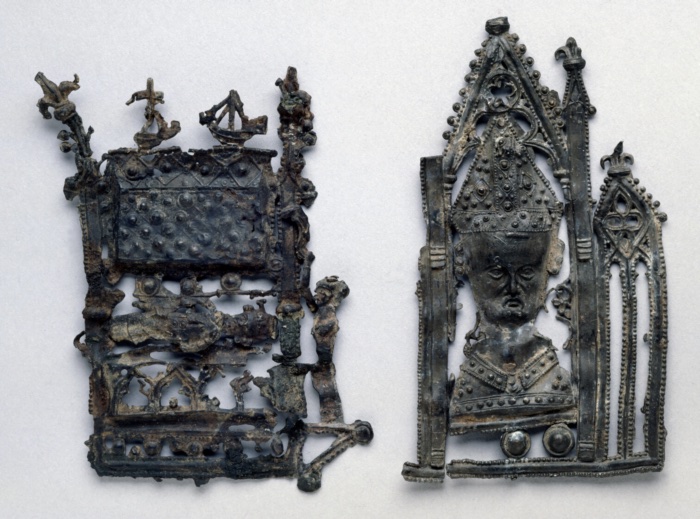
The Museum’s own photograph of the piece places it alongside a second, related fragment: a mitred bust of Becket himself, the type of badge that depicted the head-shaped reliquary believed to hold his skull, one of the most common souvenir forms sold at Canterbury. You can look up the record for accession number AN1988.397 in the Ashmolean’s online collection.
Few medieval deaths were turned into souvenirs quite so thoroughly as Becket’s. He was cut down by four of Henry II’s knights in his own cathedral in 1170, an act so shocking to contemporaries that he was canonised within three years, and Canterbury became one of the great pilgrimage destinations of Europe almost overnight. Pilgrims also carried away small flasks, ampullae, filled with water said to contain drops of the martyred archbishop’s blood, sold as a cure for everything from fever to blindness.
Modern reproductions
I’ve found a wonderful site that creates pewter reproductions of badges like this one, needless to say, I’d love to have the whole collection. Here are a few examples, but do visit the site and see the many versions available… all at an astonishingly reasonable price!
.jpg)
This is a close match to the mitred bust shown beside the shrine in the Ashmolean’s own photograph above, the same essential design, mitre, beard and jewelled collar, still being cast in pewter today exactly as it would have been cast in the fourteenth century.
.jpg)
This scallop shell belongs to St James, and to the pilgrimage routes converging on Santiago de Compostela in north-western Spain. The story goes that pilgrims walking those routes would gather actual shells from the Galician coast as proof of having reached the end of the road; stallholders soon realised there was no need to wait for the genuine article when a cast pewter version would do just as well. The shell went on to become shorthand for the entire idea of pilgrimage, adopted at shrines as far afield as Mont-Saint-Michel and Cologne that had nothing to do with St James at all.
‘Becket Slain’, showing Saint Thomas á Becket, slain in the cathedral:
Surviving badges of the murder scene show it in surprising detail: the knights are sometimes individually identifiable by the heraldry on their shields, and one even bears a small pun, a bear’s head shield for the knight Reginald FitzUrse, whose surname meant ‘bear’ in Latin.
‘Becket’s Exile’, showing Saint Thomas á Becket during his sea journey to France:
The murder is the scene everyone remembers, but it was the falling-out beforehand that made Becket’s story so resonant. He and Henry II had once been close friends; Becket’s elevation to Archbishop of Canterbury in 1162 was meant to secure royal influence over the Church, but Becket instead defended ecclesiastical independence so fiercely that he fled to France for six years rather than submit. This badge captures that earlier, less violent chapter, a reminder that the cult of a martyr usually has a longer and messier story behind it than the single dramatic image people remember.

This one is gentler, a mid-fourteenth-century devotional badge depicting a heart carried aloft by an angel, generally understood as the Angel of the Annunciation, and associated with the cult of the Virgin Mary’s sorrows. Not every badge marked a specific pilgrimage destination; some, like this, functioned more as portable acts of devotion, worn for protection or simply as a visible statement of faith, in much the same spirit as a modern pendant or charm.

The genuine Yorkist sun badge has a good story attached: before the battle of Mortimer’s Cross in 1461, the Yorkist army reportedly saw what looked like three suns in the sky, an optical phenomenon now called a parhelion, and chose to read the omen as one of victory rather than alarm. They duly won, and the sun, often combined with the white rose, became one of the house’s enduring badges. It is worth saying, though, that plain sunburst designs of this kind are sometimes misattributed; specialist badge-makers occasionally identify near-identical examples as Star of Bethlehem devotional badges rather than Yorkist livery at all. The meaning of an image is not always settled, even among people who study them closely.
The lovely ‘Star and Crescent’:
It is tempting to read a star and crescent together as a crusading symbol, a Christian star triumphing over a Muslim moon, and that interpretation does turn up in popular accounts. The history is less tidy. The star-within-crescent motif is far older than the Crusades, appearing on Byzantine and Sassanid Persian coinage centuries earlier, and its association with Islam specifically only hardened much later, through the state symbolism of the Ottoman Empire. Even on royal seals from the crusading period itself, historians are now generally sceptical that the design was meant as anti-Islamic triumphalism at all, since the crescent had not yet become a settled symbol of the ‘infidel’ in the way later popular memory assumes. A small badge, in other words, can carry a much longer and more tangled history than its apparent meaning suggests.
There are many wonderful treasures to be found at this site, so I encourage you to explore Steve Millingham Pewter Replicas, I don’t think you’ll find such fine craftsmanship for such an affordable price anywhere else.
Now, if I could only find a similar outlet that sold milagros and votive offerings. 🙂