
I remember being a child watching Saturday morning cartoons in California in the 1970s. One of my favourite shows was In Search Of… with Leonard Nimoy. Each week they explored some kind of mysterious phenomenon, from the Bermuda Triangle to Bigfoot, Atlantis to learning ESP. But the episode that caught my imagination most completely was “The Magic of Stonehenge.” From that point on, whenever asked where I would choose to go if I could go anywhere in the world, the answer has almost always been Stonehenge.
When I finally visited the UK as an adult, Stonehenge and Avebury were top of my list. People had warned me it might be disappointing: that visitors couldn’t get close to it any more, that it would be impressive but wouldn’t live up to a lifetime of expectation. It took my breath away regardless.
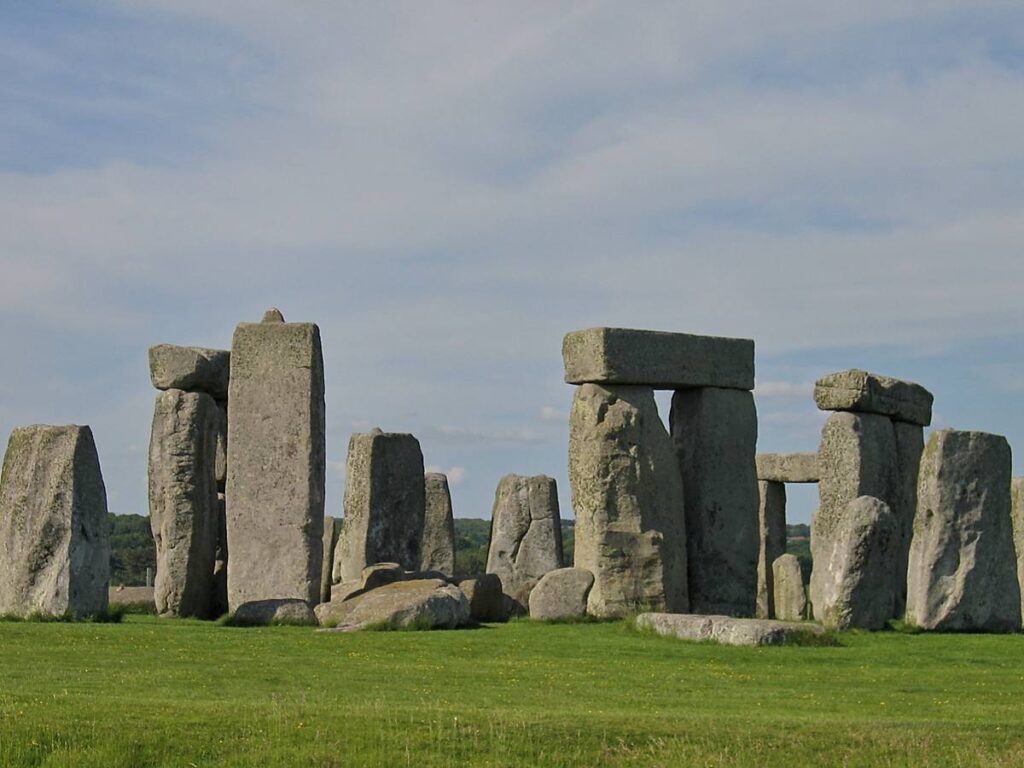
June, 2007
Since then I’ve been back a few times, and had heard it was possible to arrange a visit before or after the usual opening hours, but had never managed it. This year an opportunity came up that went further still. Friends from the Oxford Pagan Moot had been invited to the private ceremony for Winter Solstice at sundown, and asked me to join them.
The ceremony is organised by the Gorsedd of Bards of Cor Gawr, Gorsedd Beirdd Côr y Cewri in Cymraeg, a Druid group whose primary purpose is to hold ceremonies at the Midsummer and Midwinter solstices under agreement with English Heritage. The arrangement has its own history worth setting down. Public ceremonial access to the stones had been effectively closed off since the exclusion-zone conflicts of the 1980s. It was only from 1995 that the British Druid Order, under Philip Shallcrass and Emma Restall Orr, began negotiating access with English Heritage, leading to the Gorsedd’s founding at Stonehenge in 1997. Even the group’s name carries its own small history lesson: Cor Gawr is not, as it’s sometimes taken to be, an ancient British name for the monument. It was coined in 1809 by Edward Davies, correcting an earlier corrupted form, itself standing in for the genuinely old Welsh name for Stonehenge, Côr y Cewri, attested since the twelfth century. A tradition barely two hundred years old, wrapped around a name eight hundred years old, wrapped around a monument five thousand years old.
We were told to dress warmer than we might expect to need and to arrive around 3:30pm. The visitor centre was still open, but most of the crowds, hundreds of people, were making their way to the exits as the site officially closed. We got inside in time to grab some extra clothing and blankets, because it was clear it was going to be cold, wet and windy when we reached the monument.
Our group was small, maybe fifty people in total. A shuttle brought us to the site as the light was quickly fading. The drummers gathered to settle on how best to lead the group to the stones, and within minutes we were approaching them, now in dark twilight. We entered the ring of stones and moved in a spiral toward the centre, marking a ceremony that has been observed on this spot, in one form or another, for roughly five thousand years. The temptation to touch the stones was strong, but we had been asked not to, and I felt it right to respect that.
For the sake of privacy, I don’t think it’s my place to describe what happened during the ceremony itself. I’ll say only that much of it followed the kind of ritual structure familiar from modern pagan practice, with the focus throughout on light: its coming and going, its cycle. At one point all the lights were extinguished, and it was otherworldly to stand in that cold darkness, barely able to make out the people beside me or the stones themselves. We held that for some time, long enough to quiet the mind and shiver the body.
When the main ceremony ended there was poetry, singing, dancing, and the sharing of food and mead. The wind was misty, wet and bitterly cold, and I was grateful for a warm wool blanket. We were allowed to stay among the stones for nearly three hours, with a few minutes at the end to wander among them on our own before the shuttle brought us back.
That boy in the seventies, watching a Saturday morning television programme about a stone circle on the other side of the world, could never have dreamt this: a private ceremony, on the winter solstice, inside the stones themselves. He’d have been ridiculously happy, and I was.
Winter Solstice, 2025