
A few miles outside Charlbury, down a lane that gives no warning of what’s at the end of it, sits the chapel of All Saints, Shorthampton. It is easy to miss, and that is rather the point. Shorthampton was built as a chapel-of-ease, a small satellite church granted to communities too far from their parish church to make the journey easily, in this case sparing the hamlet a walk into Charlbury itself. In 1109 the Benedictine monks of Eynsham Abbey were granted Charlbury and its outlying hamlets, Shorthampton among them, and the present building dates from their stewardship. The earliest written reference to the chapel comes from the Eynsham Abbey cartulary in 1296, which records that three services a week were said there with two clergy in attendance, evidence of a community taking its small chapel seriously from the start. The monks cared for it until the dissolution of the monasteries under Henry VIII, after which, in 1555, it passed into the care of St John’s College, Oxford, where responsibility for it has remained ever since.
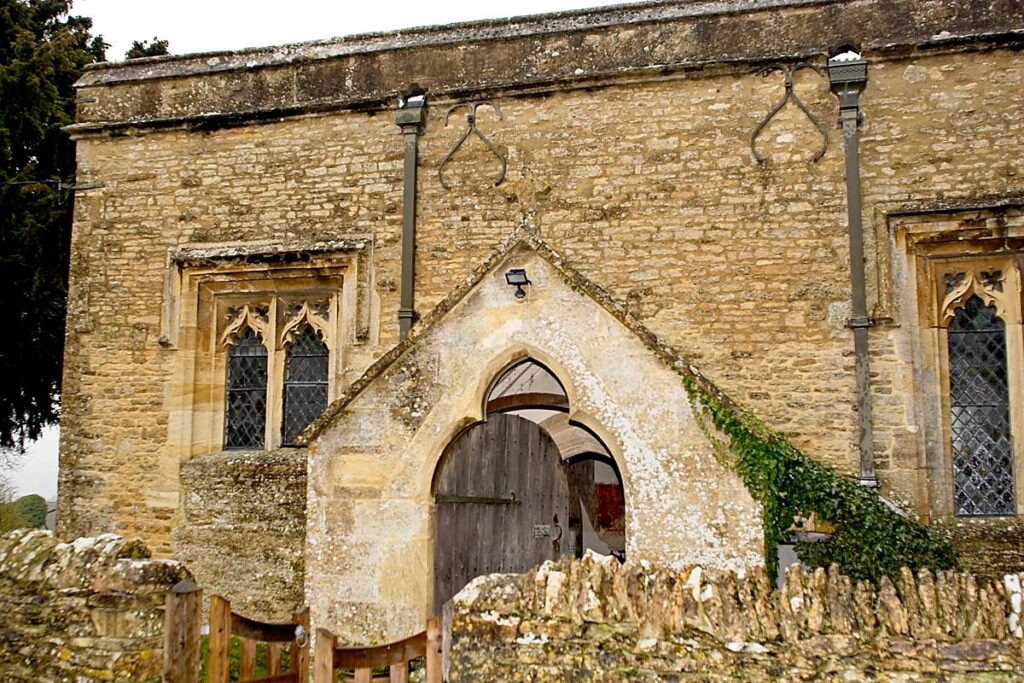
What makes Shorthampton remarkable is not its size, which is modest, but what is painted on its walls. In 1903 the chapel’s restoration was taken in hand by Vernon Watney of nearby Cornbury Park, carried out under the architect John Belcher, and it was during this work that a series of medieval wall paintings was uncovered beneath three and a half centuries of Puritan whitewash. Belcher invited an architect and antiquarian named Philip Mainwaring Johnston, by then already known for his careful surveys of early church paintings, to search out and record what had been found. Johnston published his findings in the Archaeological Journal in 1905, with a full set of plates: a plan and section of the building, photographs of the chapel and its font, sketches of the carved corbel heads in the nave, and coloured drawings of the paintings themselves. Those plates remain the fullest visual record there is of how the paintings looked at the moment they re-emerged into daylight.
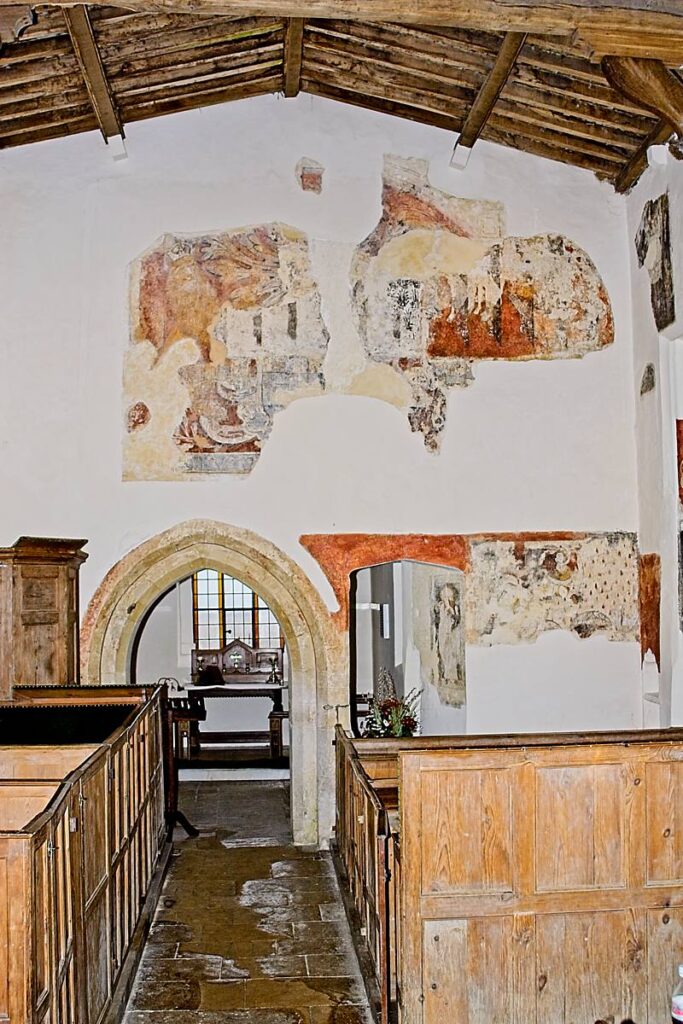
Johnston’s account opens with something close to astonishment. Describing the painting of St Sytha on first being uncovered, he wrote that its colours were extraordinarily fresh, as though it had only lately been finished, and credited the whitewash of the Reformers, of all things, with the preservation. It is a nice irony to sit with: the same coat of limewash applied to erase these images had also, accidentally, kept them safe for three hundred years.
Visiting the chapel today, more than a century after Johnston’s survey, I found that irony cutting the other way. Comparing what remains on the walls now against his written descriptions of 1905, it is clear how much has been lost in the time since, this time to open air, damp, and the ordinary wear of more than a hundred years without the whitewash’s protection. Johnston’s plates are exact enough that I can place his work directly against my own photographs and see precisely what the twentieth century took that the Reformation, in its own way, had spared.
St Frideswide
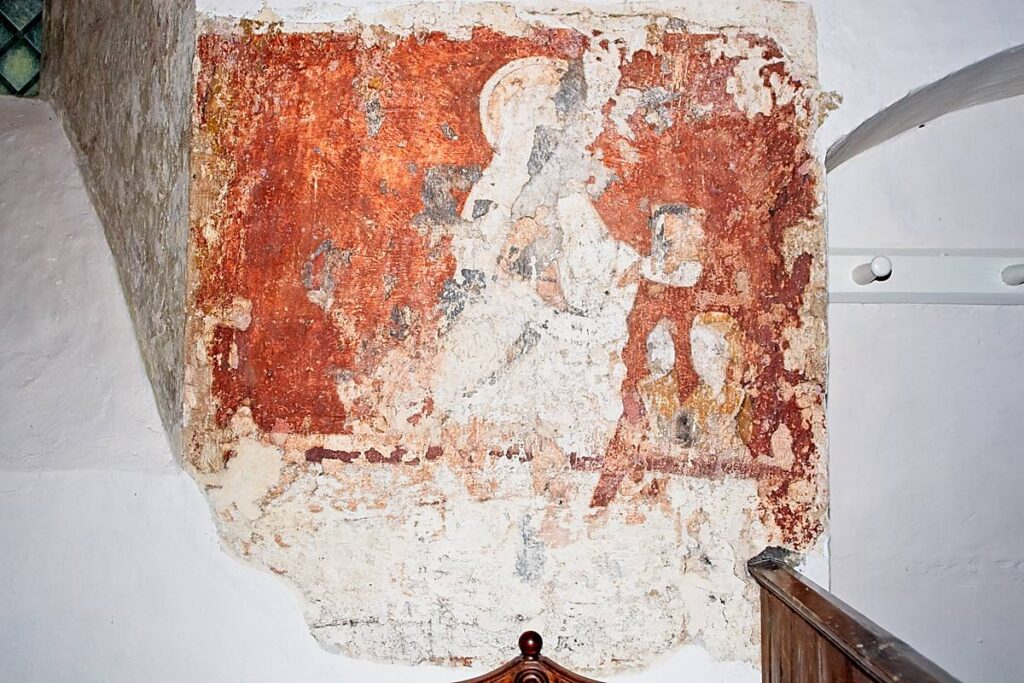
Eastward of the old Norman window, Johnston uncovered a painting, partly overlaid by a later one, of St Frideswide, Oxford’s own patron saint, shown teaching the youth of the city to read from a heavy bound book, with an ox standing at her side and a boy kneeling before her, hands raised together in attention. Johnston credited a colleague, the Reverend E. S. Dewick, with working out the identification. Frideswide paintings of any date are rare enough that even this faint, damaged example struck Johnston as a genuine addition to the record. A more recent reading of the same kind of composition elsewhere has suggested that scenes like this one sometimes show St Anne teaching the young Virgin Mary rather than Frideswide and a pupil, since the visual formula for the two scenes is very similar, so the identification carries a little more uncertainty than Johnston’s confident attribution implies. Either way, a teaching woman at the centre of the image feels apt for a chapel otherwise so concerned with work, service and care. Frideswide’s own cult is not simply a historical curiosity, either: a four-day pilgrimage route in her name, running from her shrine at Christ Church to Reading Abbey, was only established in 2024, a reminder that the kind of devotion this chapel’s walls were built to encourage has not entirely vanished from Oxfordshire.
St Thomas of Canterbury, or possibly St Edmund of Abingdon
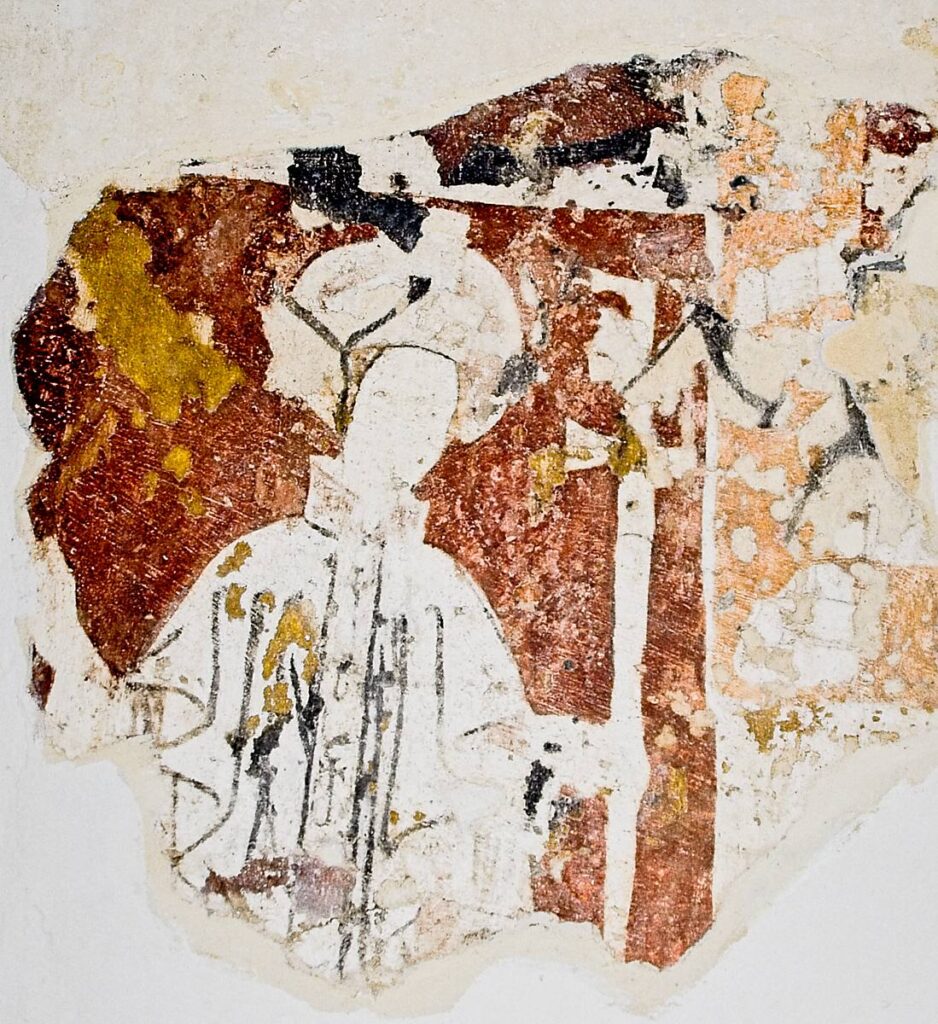
Close beside Frideswide, on the same north wall, is the upper part of a mitred archbishop (Plate 7), painted with no name or emblem to confirm his identity. Johnston’s own best guess, offered as a presumption rather than a certainty, was St Thomas of Canterbury, the most famous English archbishop-saint by far, whose cult, as anyone who has spent time with English medieval pilgrimage badges will know, was extraordinarily popular and durable right up until Henry VIII’s reign brought a deliberate campaign to erase it. Johnston supported the identification by comparing the Shorthampton figure with a securely dated and similarly devotional image of Becket at Hauxton Church in Cambridgeshire, painted some two and a half centuries earlier, noting the family resemblance in pose even allowing for the gap in date.
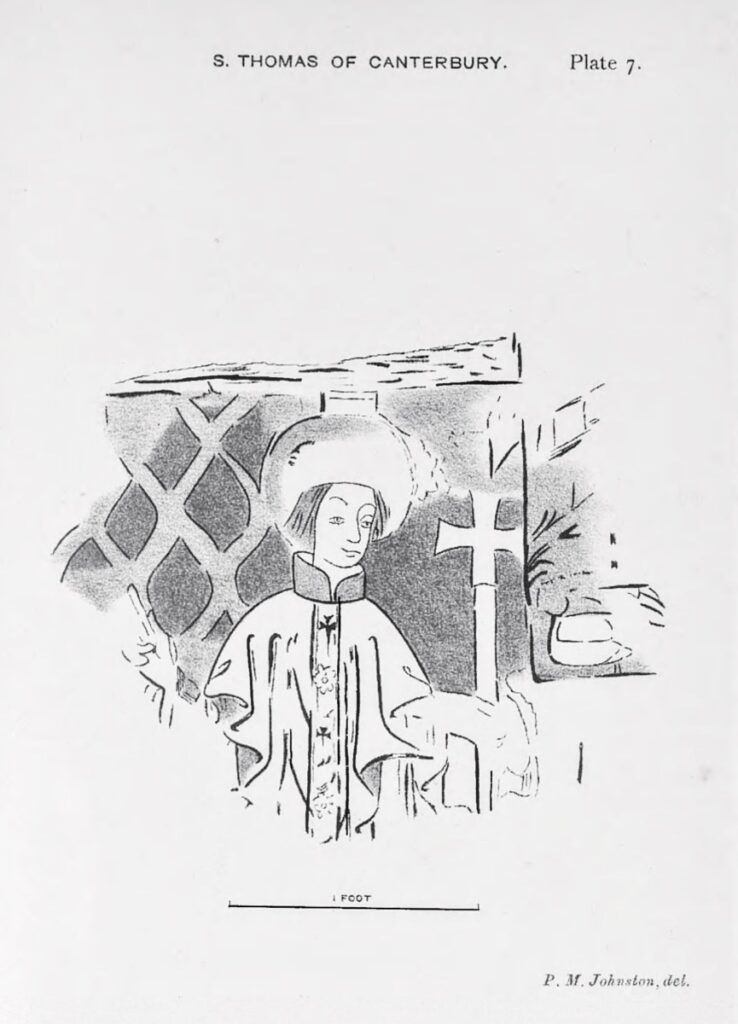
The parish’s own more recent guide to the paintings proposes a different and quite specific alternative: St Edmund of Abingdon, whose father had become a monk at Eynsham Abbey itself, the very house that held the living here, and two of whose sisters were prioresses at nearby religious houses. That is a real local connection that Becket cannot match, and it is offered as a reasoned possibility rather than a settled correction to Johnston. Without a surviving name or emblem, the figure may simply never be identified with certainty, Becket and Edmund both have a claim, one resting on the wider fame of the cult and a comparable dated example elsewhere, the other on a specific and unusually well-evidenced local tie. I rather like that the question stays open. Johnston’s sketch shows considerably more of the figure than survives on the wall today, which has lost most of its legible detail in the century since.
The miracle of the clay birds
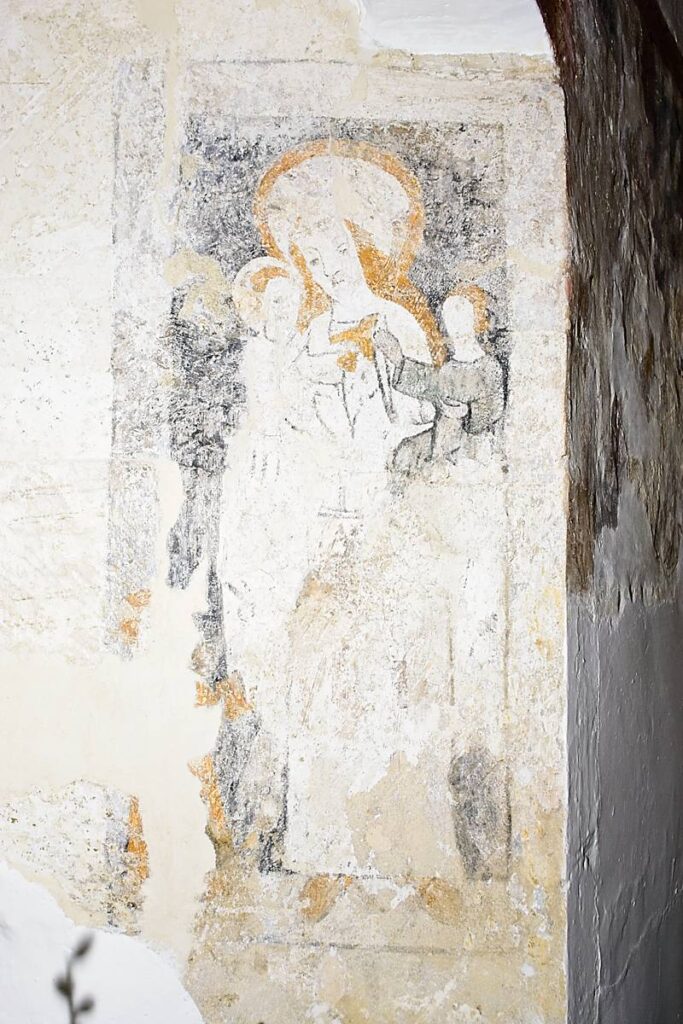
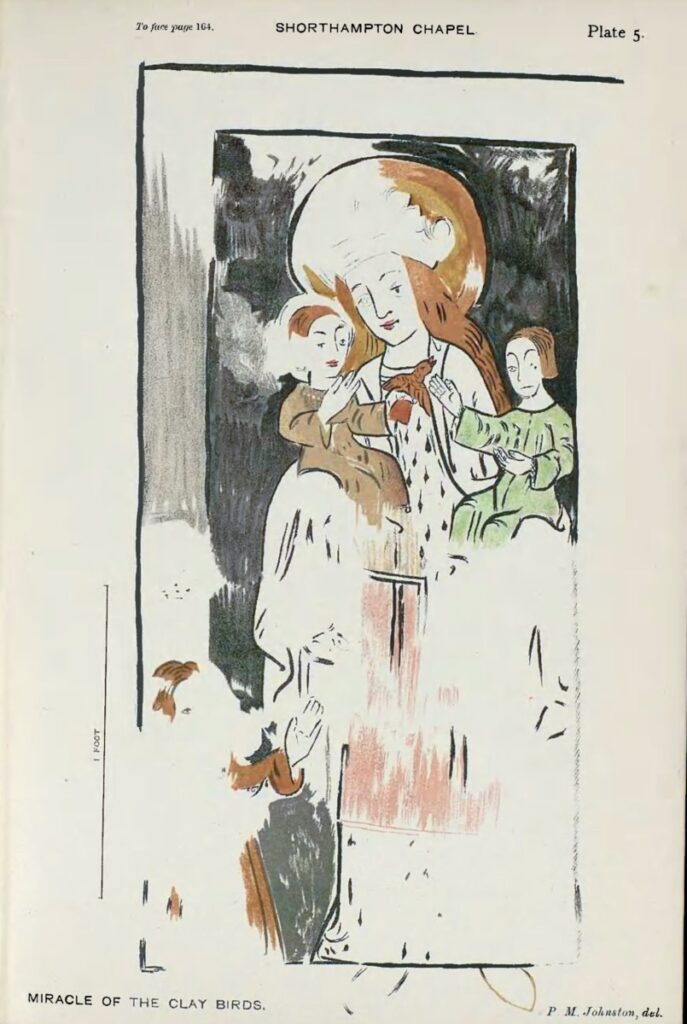
Painted on the splay of a squint, a diagonal opening cut through the wall beside the chancel arch to give a clear sightline into the chancel, in a position Johnston could not recall ever having seen used for a painting in any other English church, is one of the chapel’s rarest images (Plate 5). It illustrates a story from the Gospel of Nicodemus, an apocryphal text never accepted into scripture but well known in the medieval period, in which the child Christ shapes birds out of river clay to amuse his young companions and then, to general delight, gives them life and sets them flying. Johnston’s drawing shows the Virgin at the centre, crowned and haloed, her hair loose down her back, dressed in an ermine-trimmed tunic, a pink robe and a pale blue mantle. She carries the haloed infant Christ on one arm while a second small boy sits on her other arm and a third kneels before her in an orange-brown tunic, all three children caught in attitudes of wonder at the bird taking flight from Christ’s hand. Johnston thought the delicacy of the drawing suggested an illuminator’s hand, very possibly a monk of Eynsham skilled with a brush, and called the subject unique among English medieval wall paintings so far as he was aware. So far as I know, that claim has never been seriously challenged since.
St Sytha
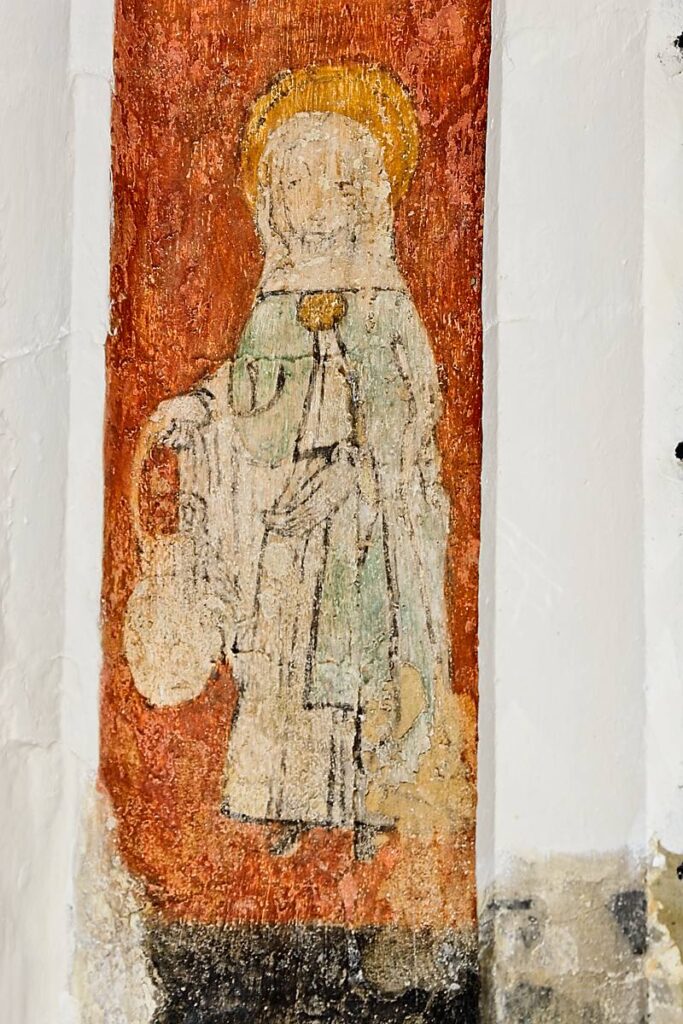
Of all the paintings, this is the one I find most affecting (Plate 6). St Sytha, known in Italy as Zita, where her cult developed and from which it likely travelled to England with Lucchese merchants, was not a grand figure. Johnston records her birth date as 1218; she was a domestic servant in a wealthy household in Lucca, renowned in her own lifetime for piety and care of the poor rather than for any miracle or martyrdom. She became, in time, the patroness of domestic servants across much of Catholic Europe, and evidently found her way into this small Oxfordshire chapel through the same trade and devotional connections between Lucca and England that also placed a shrine to the English St Edmund in Lucca’s own cathedral.
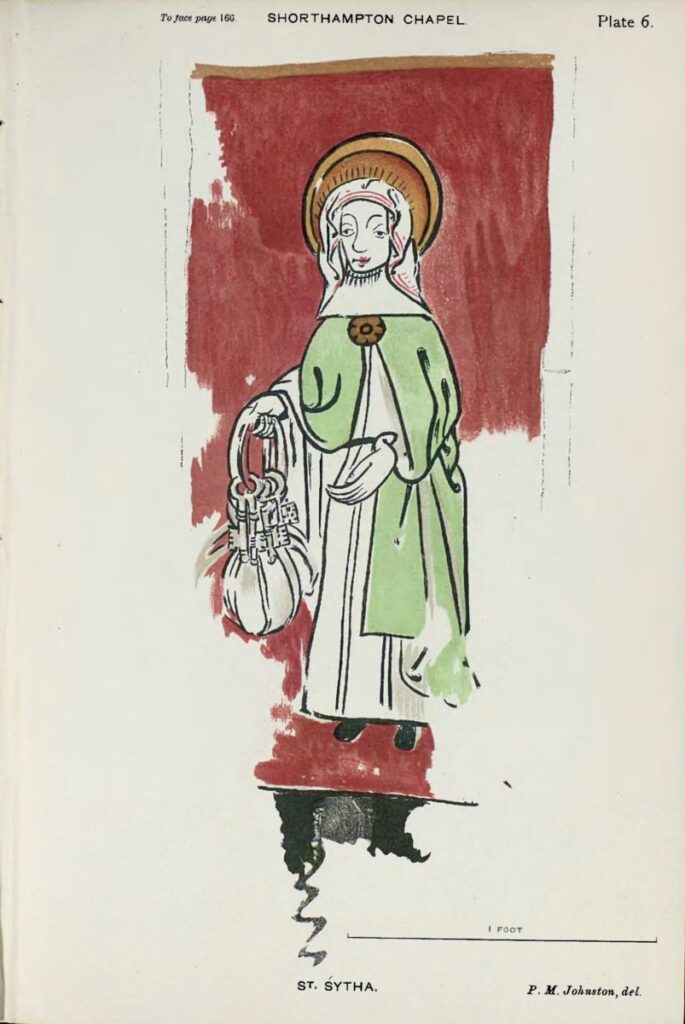
She is shown carrying a bag, perhaps meant for scraps of food for the poor, and a set of four keys, the trust eventually placed in her by the family she served. Johnston was careful to distinguish her from the similarly named St Osyth, a Mercian saint who would otherwise fit this part of England rather well, but whose attributes don’t match what’s painted here; the keys and purse settle the matter in Sytha’s favour. It was this image, on first being uncovered, that struck Johnston as looking as though it had only just been painted. What remains now suggests just how much an unprotected century can take from a painting that briefly looked, on the day it was uncovered, finished only yesterday.
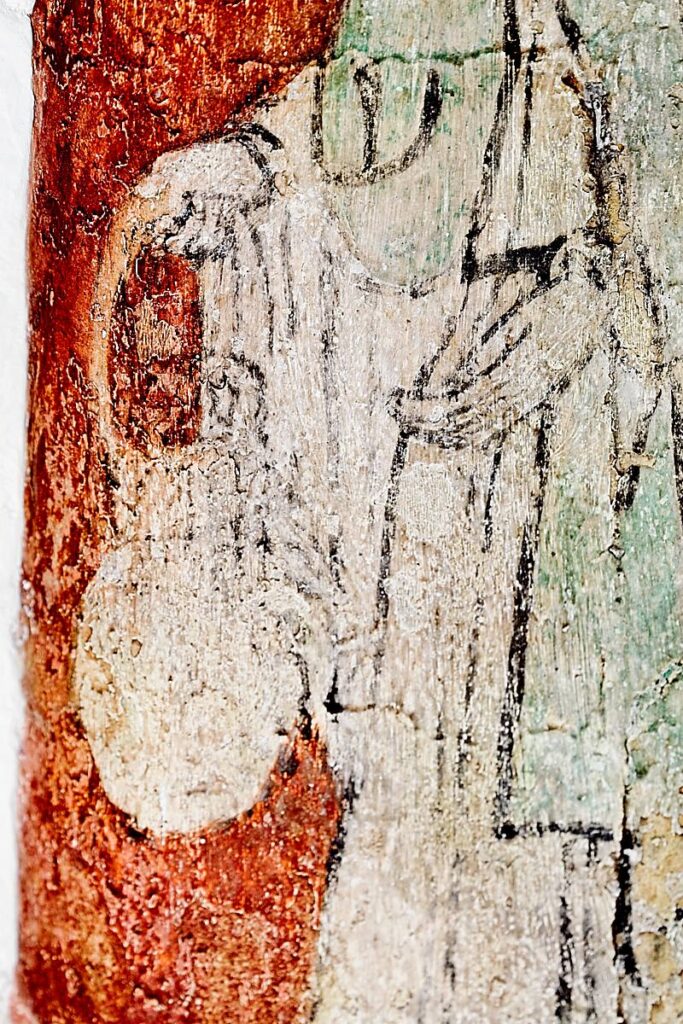
It is a small, quietly radical idea for a parish wall: that the patron saint watching over a rural Oxfordshire community making its peace with hard, unglamorous work was herself nothing but a servant.
The Doom, and its hell cauldron
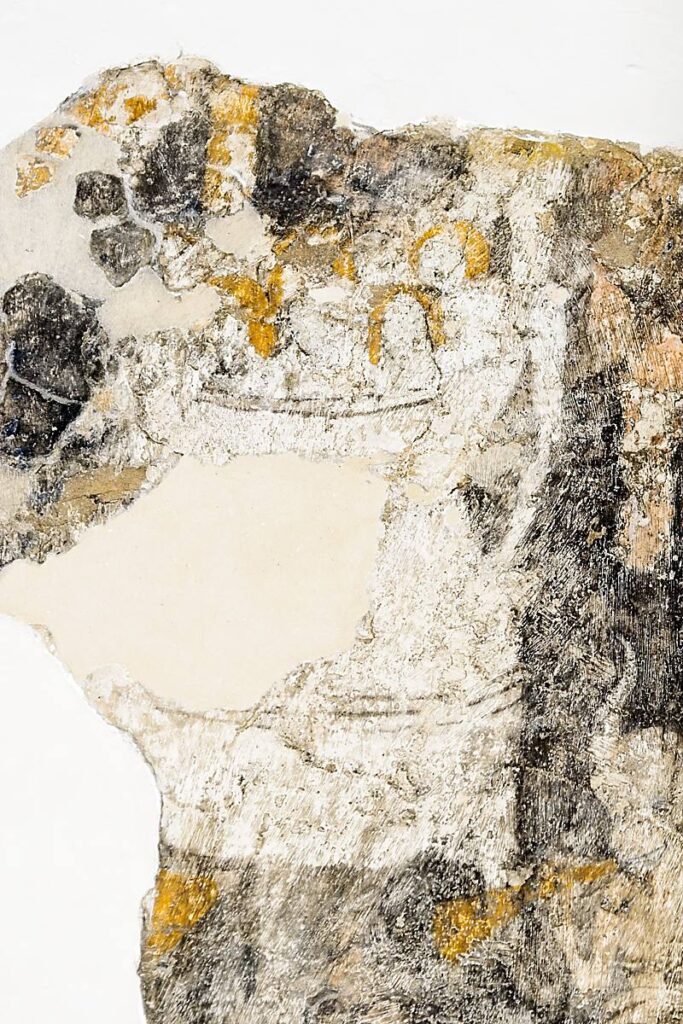
The largest single subject in the chapel, by far, was a Doom, a depiction of the Last Judgement that once covered the whole upper part of the east wall and continued onto the north and south walls beside it, comparable in scale to surviving examples at North and South Leigh elsewhere in the county. Almost nothing remains of its Death on the Pale Horse, on the north side. On the east wall, a Resurrection survives in better fragments: figures climbing from elaborately carved stone coffins against a red ground scattered with grass and flowers, one clearly a woman in a white shroud. The Heaven half of the composition, with the saved, Christ in judgement, the Virgin, and the archangel Michael weighing souls, none of that had survived to Johnston’s day. What had survived, in reasonable condition, was the Mouth of Hell: painted as the open jaws of a whale, with two snarling blue demons hauling a line of condemned souls in on a spiked chain, watched by a scatter of small heads above that Johnston guessed were further souls being forked down by Satan himself.
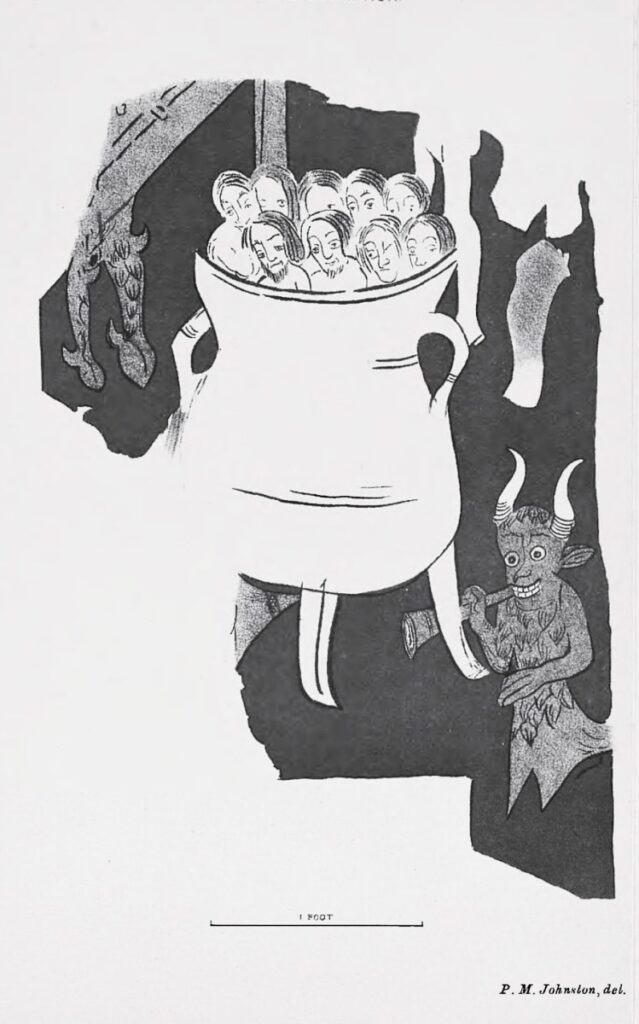
The most arresting fragment, though, sits separately on the south wall (Plate 7). It is the hell cauldron, and Johnston’s description of it remains the best account there is. He noted that the great two-handled pot, standing on short legs against a black background, resembled nothing so much as an oversized pewter drinking measure, and suggested the resemblance was deliberate, a warning against the drunkenness that too often disgraced the parish’s own Whitsun ales and church-ale drinking sessions. Ten miserable faces, two bearded and clearly meant for men, the rest intended as women, are crammed into its rim. A bellows nozzle beneath the pot fans the flames, and beside it a small horned demon, tailless and oddly unfinished, blows a horn, perhaps in mocking reference to the music that would have accompanied those same parish drinking sessions.
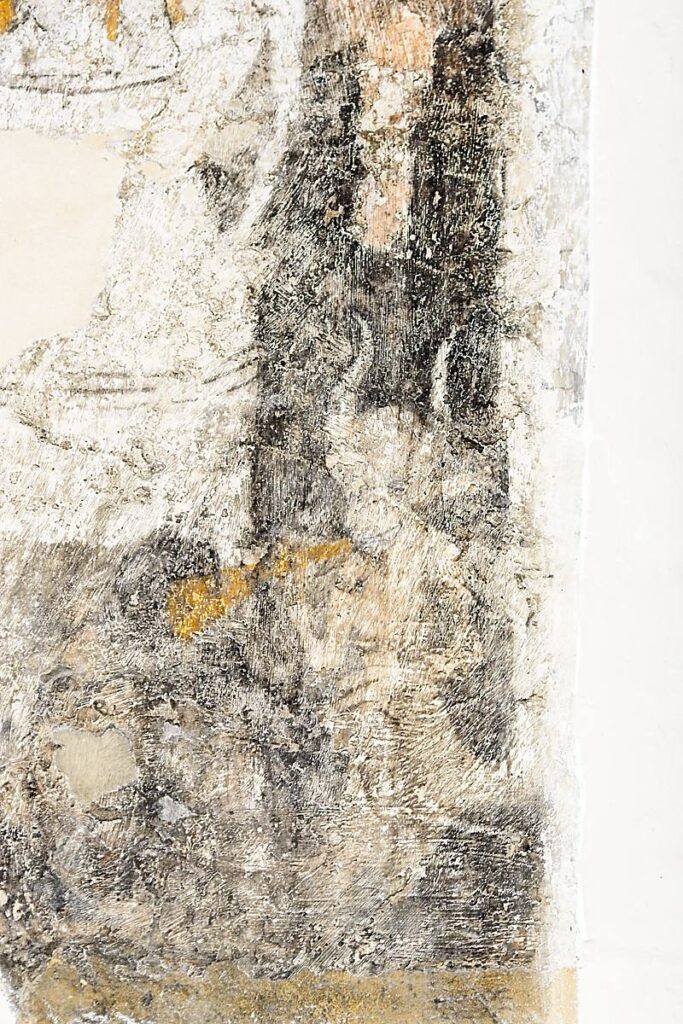
Above the pot, in Johnston’s most memorable observation, a demon and a naked figure are caught on a kind of see-saw balanced on a post, the demon weighing down one end while the human figure, having evidently just been thrown from her seat, clutches the tilted plank with her clothes falling away behind her, about to be dropped straight into the cauldron’s mouth. Johnston judged the whole scene irresistibly funny despite its coarseness, and concluded, reasonably, that a fifteenth century Oxfordshire congregation needed blunt warnings rather than delicate ones.
St Eligius
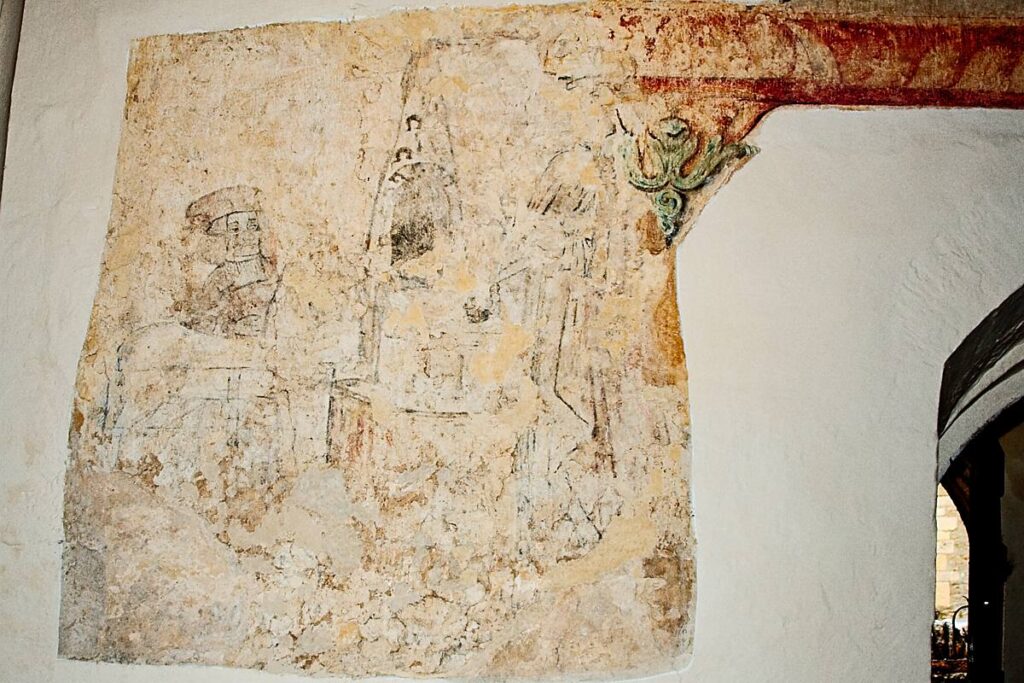
Probably the latest of the chapel’s paintings, executed in sparing grey and black outline rather than the fuller colour of the earlier work, depicts St Eligius, known in England as St Loy, a seventh-century bishop and former master goldsmith who became patron of metalworkers (Plate VII). The story shown is his most famous miracle: faced with a horse too possessed to be shod safely, Eligius simply removed its leg at the joint, fitted the shoe at leisure with the leg held in his tongs, and reattached it once the work was done. The painting shows the saint at his forge, vested as a bishop, the horse braced in a wooden frame to support it while it stands short a leg, and behind it the horse’s owner, a well-to-do citizen in the square flapped hat fashionable around 1500, watching the whole procedure. The bishop himself has lost his head to later damage, the one significant loss Johnston recorded in this particular image.
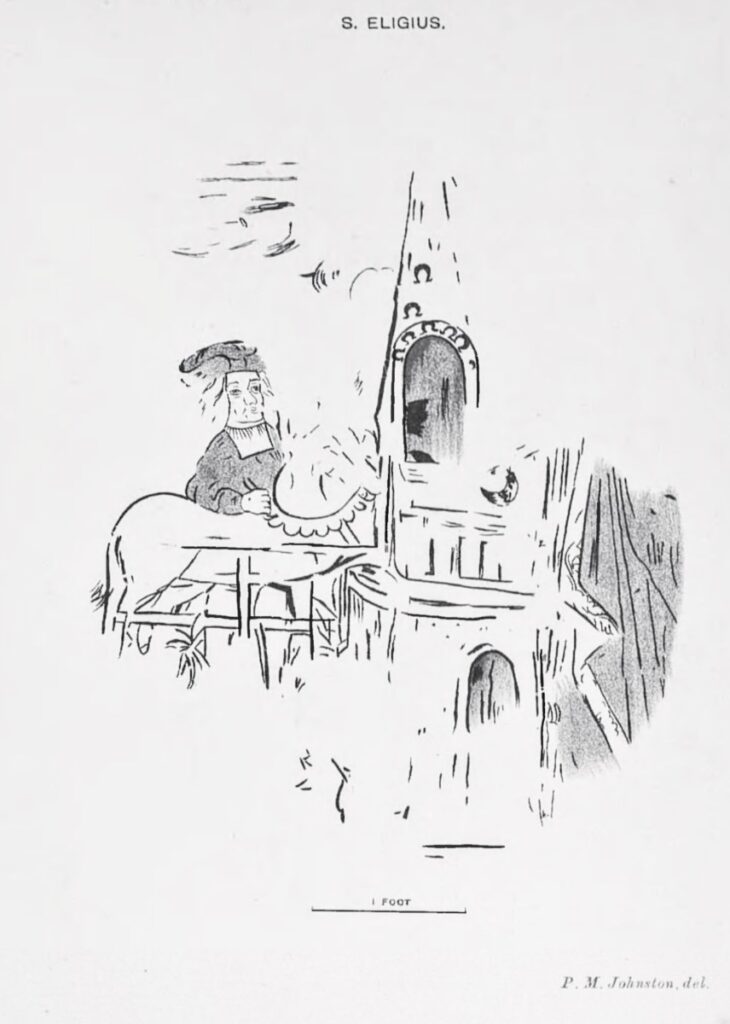
Johnston knew of comparable depictions of this exact miracle elsewhere, including a bas-relief at Or San Michele in Florence and another, photographed for him by a friend, at Durweston in Dorset (Plate VIII). It is worth adding, since Johnston himself was already drawing the comparison between Oxfordshire and Florence, that the same scene, the same miracle, the same severed leg held at an anvil, was painted by Sandro Botticelli within a few decades of Shorthampton’s own version, as one panel of the predella beneath his Altarpiece of St Mark, now also in the Uffizi. The two paintings could not be more different in ambition, one a small predella panel beneath an altarpiece for one of Florence’s great confraternities, the other a few square feet of plaster in a chapel-of-ease serving a handful of farming families in Oxfordshire, and yet they tell exactly the same story, because for a time it was simply part of the common visual currency of Christian Europe, available to a Florentine master and an anonymous village painter alike.
What else was here
A separate small chapel formed within the widened south wall around 1400 held a painting of the Agony in the Garden, Christ kneeling among the trees of Gethsemane with a demi-angel above bearing a scroll, the background scattered with drops of blood in a deliberate echo of the Gospel of Luke. By about 1460 this had been covered with a second painting, apparently of the Virgin, of which only a single small head survives, painted by the same hand responsible for the archbishop figure described earlier. And on the west wall, where a later window has destroyed most of the image, a single painted wing and a few trees are all that remain of what was once a large St George and the Dragon, probably dating from around the same 1400 rebuilding as the Agony.
Johnston also recorded painted boards bearing the Creed and other texts, added to the nave walls between the late seventeenth and early nineteenth centuries, which in most cases survived precisely because the medieval paintings beneath them had already been destroyed before the boards went up. A small mercy, of a kind: the same Reformation-era impulse to whitewash and overwrite that erased so much also occasionally protected, by accident, whatever scraps were left.
Conclusion
Johnston closed his own account with a small, quiet rebuke to anyone tempted only to mourn what such restorations inevitably reveal has already been lost. Better, he thought, to get on with finding, recording and preserving what remains than to spend too long lamenting what doesn’t. It’s a fair instruction, and over a century later, with his plates in one hand and my own photographs in the other, it still feels like the right way to spend an afternoon at Shorthampton.
Sources
Philip Mainwaring Johnston, “Shorthampton Chapel and its Wall-Paintings,” The Archaeological Journal, vol. 62 (1905), pp. 157–171. The primary source for almost everything above, including all the plate references.
E. T. Long, “Medieval Wall Paintings in Oxfordshire Churches,” Oxoniensia, vol. 37 (1972), Oxfordshire Architectural and Historical Society. An independent later survey covering Shorthampton alongside other county churches.
Jennifer Sherwood and Nikolaus Pevsner, Oxfordshire, The Buildings of England (1974).
Guide to Shorthampton wall paintings, Parish of Charlbury with Shorthampton. Source for the St Edmund of Abingdon identification discussed above.
New St Frideswide’s Way Pilgrimage Walk Launches, Christ Church, University of Oxford, June 2024.
Church of All Saints, Shorthampton, list entry 1053112, Historic England. Grade II* listed.